If I Had Your Face by Frances Cha and impossible k-beauty standards

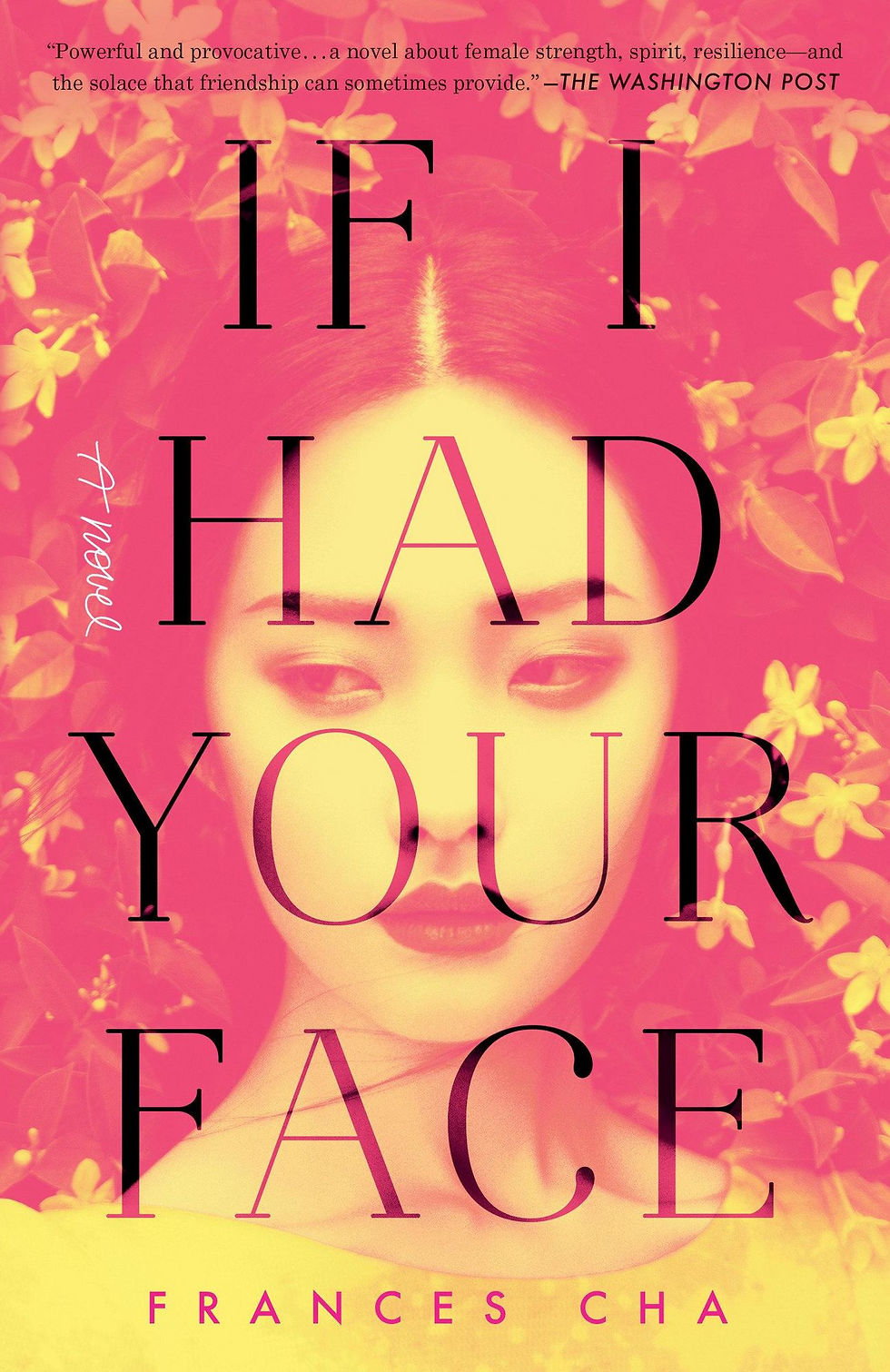
If I Had Your Face by Frances Cha is a brutally honest look at contemporary Seoul, told through four young women who all come from difficult backgrounds. It's sharp and unforgiving as social critique, and it doesn't pretend anything will get better in the end. I also appreciated that it calls out a side of Korean culture that can be stifling to talk about openly, especially around beauty, class, and women's place in all of it.
Kyuri is a salon girl who believes that changing her face will change her fortune. She entertains wealthy men for a living, in an industry that runs entirely on being the most beautiful woman in the room, and she finds herself falling for one of her clients even as she watches the uglier side of men whose money makes them look respectable.
Miho grew up in an orphanage and won her way out through an art scholarship in New York, where she was folded into a circle of wealthy Koreans. She thinks she's above the obsession with cosmetic surgery and beauty standards, until she realizes how much status and appearance actually shape her relationship with her wealthy boyfriend.
Ara is a mute hairstylist, the daughter of servants from a small town, fixated on a K-pop idol she'll do almost anything to meet. Her best friend Sujin is saving for the kind of surgery that's become less choice than expectation for young women. And Wonna is the final character, she's married and trying to have a child, representing just what happens when an entire generation can't picture a stable future.
None of the four gets a Cinderella ending. What they get instead is the ability to keep going, which the novel seems to argue is the only ending available. Materialism, beauty standards, and rigid social structure is what actually shapes who these women love, fear, and become. And the scary part is how to deal with that, becasuse everything else is up to them.
As pure entertainment, I was completely invedted. I'm always drawn to work that gives a well-researched, unglamorous look at a culture we only usually see through its exports. International impressions of South Korea are often overwhelmingly positive, thanks to K-pop and K-dramas, and I say that as a big fan of both. So a novel like this, where misogyny, sexual exploitation, and the pressure to look a certain way are center stage is always fascinating to explore.
I think perhaps the pacing feels a bit uneven, the book leans hard on ambiguity and unanswered questions, and four points of view is a lot to juggle. Kyuri, Ara, and Miho flow together naturally; they're linked through Ara and Miho's childhood friendship, plus Sujin. Wonna lives in the same building but spends most of the book feeling separate from the others, which left that thread feeling a little unfinished.
This novel reminded me of the 2015 drama Oh My Venus following an Ugly Betty concept that tackles the topic of weight and self-worth, following a woman who transforms her body after years of being overlooked (and she's not even that fat mind you), only to grapple with whether she's finally "acceptable" or just newly visible. My ID Is Gangnam Beauty (2019) goes further, following a woman who gets surgery to escape years of bullying over her looks, only to discover that being conventionally attractive brings its own brutal scrutiny (and I never even finished the whole show out of frustation). While not as successful, I think both shows are interested in the same idea that Cha's novel explore: that attractability isn't a fixed thing you get to "keep", it's a constantly moving target.
Something that kept on coming to my mind while reading is that even though Korean beauty standards aren't identical to Western ones, the pressure functions the exact same way everywhere: women's bodies treated as things to be managed, judged, and improved, never just lived in.
4/5 ✰
Comments